Muhammad Ali Quotes: His Real Words, With the Source
Few people in sports history talked as much, or as well, as Muhammad Ali. He rhymed before fights, teased reporters, predicted the round and then delivered it. He also said things that cost him his title, his money and four years of his career. That is why his words still matter: he backed them with his life.
The trouble is that the internet is full of lines with his name on them that he never said. This page sticks to the real ones, each with the date, the occasion or the publication where it appeared. When a famous “Ali quote” turns out to come from somewhere else, we tell you. And when you want something for a gym wall, a caption or a card, you will find short lines of our own, clearly marked as Pretty Phrases originals.
Who was Muhammad Ali?
He was born Cassius Marcellus Clay Jr. on January 17, 1942, in Louisville, Kentucky. He started boxing at twelve, after his bicycle was stolen and a police officer who ran a local gym suggested he learn to fight first. At eighteen he won the Olympic gold medal as a light heavyweight in Rome in 1960.
On February 25, 1964, in Miami Beach, he beat Sonny Liston to become heavyweight champion of the world. Soon after, he announced that he had joined the Nation of Islam and changed his name to Muhammad Ali. In 1967 he refused to be drafted into the Army during the Vietnam War. He was stripped of his title, convicted and banned from boxing. In 1971 the U.S. Supreme Court overturned the conviction.
He came back to win the title again against George Foreman in Kinshasa, Zaire, in 1974, in the fight known as the Rumble in the Jungle. A year later came the Thrilla in Manila against Joe Frazier, one of the hardest fights ever seen. He was diagnosed with Parkinson’s disease in 1984, lit the Olympic cauldron in Atlanta in 1996, and died on June 3, 2016, at 74.
His most famous fight lines
These are the words that made him famous before he was even champion. Many of them were rhymes, written to sell tickets and to get inside an opponent’s head.
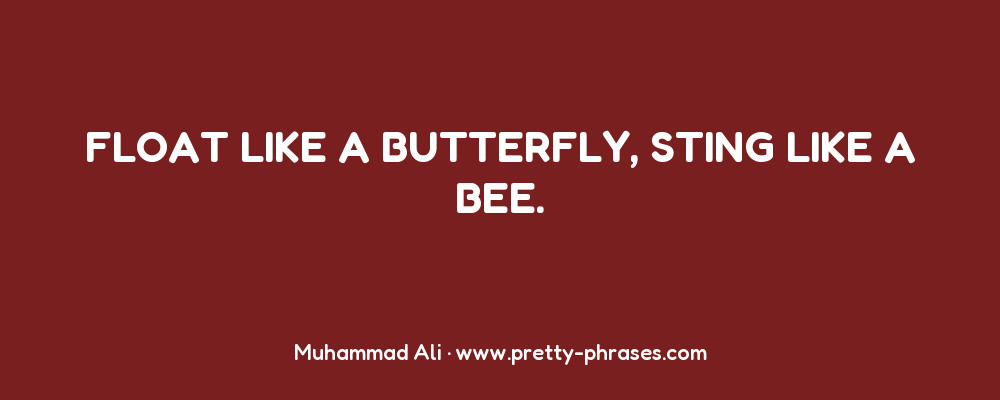
- “Float like a butterfly, sting like a bee.”
— Muhammad Ali, then still Cassius Clay, before the first Sonny Liston fight, Miami Beach, February 1964. He worked the rhyme out with his cornerman Drew “Bundini” Brown, and kept using it for the rest of his career. - “I am the greatest!”
— Muhammad Ali. He said it so often in the early 1960s that it became the title of his comedy and poetry album, I Am the Greatest, released by Columbia Records in 1963. - “I shook up the world.”
— Muhammad Ali, in the ring after beating Sonny Liston, February 25, 1964. Almost nobody had given the 22-year-old a chance. - “I’m so mean, I make medicine sick.”
— Muhammad Ali, from the rhyme he recited before the Rumble in the Jungle against George Foreman, 1974. In the same poem he boasted of having wrestled an alligator and thrown thunder in jail.
Ali said later that much of the bragging was a show. He had learned it from the wrestler Gorgeous George: if people pay to see you lose, they still pay. The confidence was real, though. He told the world what he would do, and then he had to do it in front of everyone.
Ali on faith, freedom and his name
Two days after winning the title, Ali surprised the press with a very different kind of statement. He was no longer just a loud young boxer. He was a man explaining who he was.
- “I don’t have to be what you want me to be. I’m free to be what I want.”
— Muhammad Ali, speaking to reporters about his faith, as reported in The New York Times, February 27, 1964.
Many people at the time refused to use his new name and kept calling him Clay, some of them on purpose and in public. Ali corrected them every time. Today it is simple courtesy to call him what he asked to be called, and every quote on this page uses that name, even for the years when the newspapers did not.
The words that cost him his title
In February 1966, Ali learned that his draft status had changed and that he could be called to serve in Vietnam. Reporters came to his house in Miami to ask for his reaction. His answer was quoted around the world:
- “Man, I ain’t got no quarrel with them Viet Cong.”
— Muhammad Ali, to reporters, February 17, 1966. Accounts of that afternoon give the wording slightly differently, but the meaning is the same in all of them.
The often-shared follow-up line, “No Viet Cong ever called me…” followed by a racial slur, is a different matter. Researchers who have looked for it have not found evidence that he said it on that day; it appeared on protest signs soon after. On April 28, 1967, in Houston, Ali refused to step forward when his name was called for induction. He lost his title the same day and did not fight again until 1970. Whatever people thought of his decision, he paid for it in the prime years of his career.
Ali on growing, training and getting older
As he aged, his interviews became more thoughtful. These two lines are among the most shared, and both have a clear source.
- “The man who views the world at 50 the same as he did at 20 has wasted 30 years of his life.”
— Muhammad Ali, interview in Playboy, November 1975. - “Suffer now, and live the rest of your life as a champion.”
— Muhammad Ali, on training, quoted in Newsweek, September 25, 1978. He said he hated every minute of training, but told himself not to quit.
The second line is a favorite for gyms and locker rooms, and it fits. Ali was not a natural lover of roadwork at five in the morning. He did it because he knew what the fights would cost if he did not.
The shortest poem in the world
In June 1975, Ali spoke to the graduating class at Harvard, at their Class Day celebration. When he finished, a student shouted, “Give us a poem!” Ali thought for a moment and answered with two words. Most people remember it as:
“Me, We.”
It is often called the shortest poem in the English language, and it is usually read as a message about community: start with yourself, end with everyone else. There is one honest footnote. The Harvard Crimson, reporting at the time, wrote it down as “Me? Whee!”, which would make it a joke about his own exuberance. Both versions have been repeated ever since. If you use it, “Me, We” is the version people know, but now you know the other one too.
Famous “Ali quotes” that are not what they seem
“Impossible is nothing.” You will find a long version of this on many posters: “Impossible is just a big word thrown around by small men…” It is beautifully written, and that is because it was written by a professional. It comes from an Adidas advertising campaign of 2004 that used Ali’s image, and the text was the work of a copywriter at the agency, not Ali. It is fine to use it as an Adidas slogan; it is not fine to present it as something Ali said.
“Service to others is the rent you pay for your room here on earth.” This line is everywhere, including on official-looking tribute pages, but we could not find a primary source for it: no interview, book or speech where Ali says it in those words. Similar ideas were expressed by other public figures. It may be his, but until a source turns up, we do not present it as a verified quote.
Short lines for gyms, captions and bios
The following lines are Pretty Phrases originals, inspired by Ali’s spirit but not his words. Use them freely on a gym wall, a team chat or a fight-night caption.
- Train like the bell is about to ring.
- Talk is cheap. Rounds are not.
- Get up one more time than you go down.
- Confidence is just preparation that learned to speak.
- The ring is small. The courage needed is not.
- Fast hands, faster comeback.
- Champions are built on the days nobody is watching.
- Stand for something, even when it costs you the belt.
- Every round you survive is a round you can win.
- Be loud about your dreams and quiet about your sweat.
Messages for athletes, kids and anyone in a tough fight
Ali is often quoted to people who need courage, not just boxers. These short messages are our own, written for different people and moments.
- For a young athlete before a big game: “You have done the work. Now go out there and enjoy it. Float a little, sting a little, and have fun.”
- For a friend starting a new job: “New ring, same fighter. They have no idea what is coming.”
- For someone in recovery or treatment: “Some fights are not won in one night. You keep showing up, round after round, and that is what champions do.”
- For a coach: “Thank you for every early morning, every correction and every time you believed in us before we did.”
- For a kid who lost: “Even the greatest lost sometimes. What made him great is that he came back.”
- For someone who took an unpopular stand: “Doing the right thing is rarely the easy thing. I am proud of you for choosing it anyway.”
How to use Ali quotes well
- Give the source: a line like “Muhammad Ali, Playboy, 1975” makes a caption or a speech more credible, and it protects you from sharing a fake.
- Keep the name: use Muhammad Ali, not Cassius Clay, unless you are talking specifically about his early years, and even then say both.
- Match the quote to the moment: the rhymes are perfect for game day; the lines on freedom and growth suit a graduation, a speech or a school project.
- Do not overdo the bragging lines: “I am the greatest” sounds wonderful from Ali and a little odd on your own résumé.
- Check before you post: if a quote sounds too polished, search for a date and a place. Real Ali quotes usually come with both.
Frequently asked questions
What is Muhammad Ali’s most famous quote? “Float like a butterfly, sting like a bee,” from the build-up to the first Sonny Liston fight in February 1964. “I am the greatest!” is a close second.
Did Muhammad Ali say “Impossible is nothing”? Not in his own words. It was written for an Adidas campaign in 2004 that featured him. The famous long version is advertising copy.
Why did Muhammad Ali refuse to go to Vietnam? He said his religious beliefs did not allow him to fight in the war, and he refused induction on April 28, 1967. He was stripped of his title, and in 1971 the Supreme Court overturned his conviction.
Float when you can, sting when you must, and always know who said the words you share. Thank you for reading Pretty Phrases.
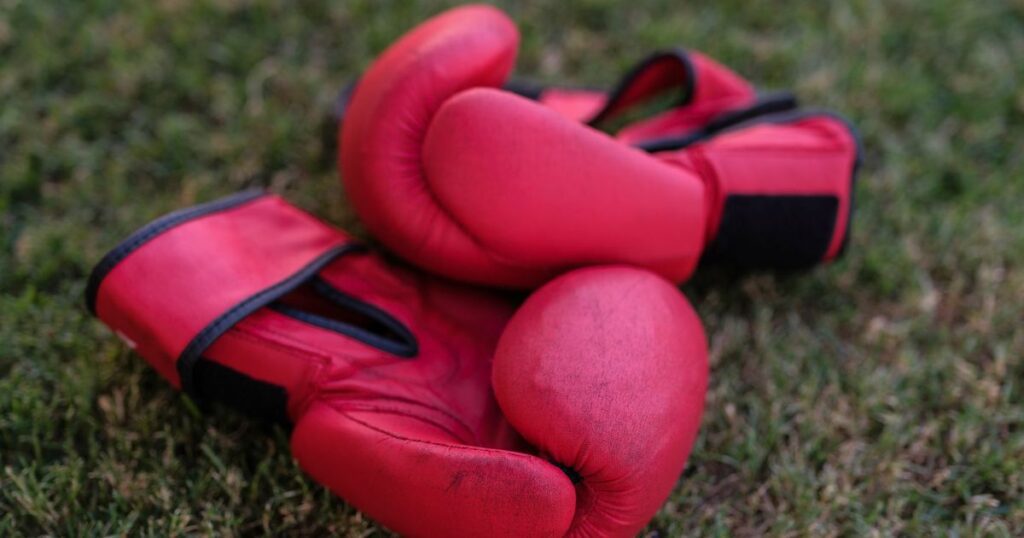
Featured photo: Engin Akyurt / Pexels.